Session Planning Overview and Resources
There are a variety of resources for Session planning. Just say "No" to Long Lines, Laps, Lectures, and eLimination. General principles include:
- Print the session plan, review ahead
- Minimize field setup changes
- Utilize assistant coaches
- Arrive early and set up fields before players arrive
- Start on time
- Keep it simple, steady pace
- Allow creative decision making by players
- Always discourage "Booting It"- encourage “dribble or pass”
Typical approaches include the "Play-Practice-Play" session structure and the "Progressive" session structure.
| Play-Practice-Play |
|
| Progressive |
|
Revs Academy Coaching Guides
Comprehensive guides based on the BLOCK methodology covering a broad range of age groups. U8 through U14 focuses on progressive methodology. See Revs Academy page for more details.
Massachusetts Youth Soccer (MYSA) Guides
Focused on play-practice-play methodology available here.
USYS Coaching Guides
Available within the Mojo app. Variety of activities covering a broad range of player actions and problems.
Four Pillars of Player Development
Long-term player development is focused around four main pillars:
| Technical | Tactical |
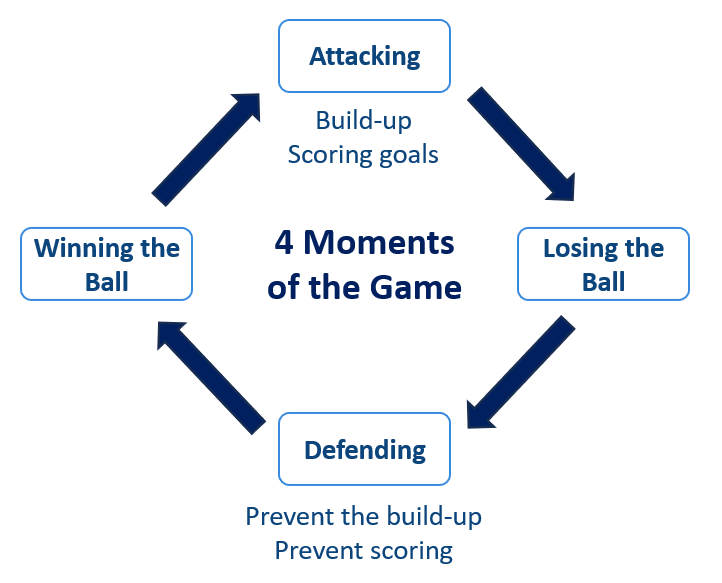
| Technical skill: player’s mastery of the physical tools used in the game. Fundamental player actions include dribbling, passing, receiving, and shooting. Aiming for fluid, second-nature control. | Tactical understanding is understanding the game, roles and positions, and a player’s ability to make effective decisions and solve problems. Recognize when to attack or defend. Four moments of the game: Attacking, Losing the ball, Defending, Winning the ball. |
| Physical | Psychological |
| Physical fitness is the athletic foundation that allows players to execute their technical and tactical abilities throughout an entire game. Key skills include agility, balance, coordination, speed, strength, stamina, and flexibility. | This is the mental toughness that helps a player maximize their abilities and overcome challenges. Key skills include confidence, decision-making, discipline, emotional stability, motivation, and goal setting. Players learn to perform under pressure. |
Four Moments of the Game
The speed at which a player perceives, decides, and acts determines their level of play.